Saturday, December 25, 2021

Focus and Wheel of Life

It’s Christmas afternoon and I am outside my farm house typing this week’s assessment on Focus and The Wheel of Life (Web-torial 16). Another thought-provoking and potentially life-changing lesson, for both coach and client. Like all good salespeople, we should only sell products we ourselves have used, so it made sense then the focus of the lesson was on us but I believe this information is for our client’s use too finally.

The first half of the lesson was on the importance of the client keeping focus on the core issue being discussed and worked on. As a coach assisting the client to identify and acknowledge her key issue that needs attention, making this clear at the beginning for the client is important. “What do you want to focus on today?” is the vital and initial question to ask whereas “How is this related to today’s focus?” is a helpful question to reel in the client’s attention once a walk around the mulberry bush occurs.

The inability to focus on the matter at hand is usually termed a distraction and an interference to the present matter being targeted. On a recent podcast I heard, the person being interviewed drew attention to the etymology of the word ‘distraction’, stating that the opposite of it would be ‘traction’ (any action that leads you to accomplish a goal) as opposed to dis-traction (any action that leads you away from a goal). In a coaching session, traction is what we are seeking for, for our client and constantly pulling her back to the core matter at hand brings traction.

I am intrigued with the writings on Ellen Langer and she has a whole chapter on focus and distraction that I so happen to be reading presently. Here are some of her thoughts on focus and distraction which we could also incorporate as we seek to help our clients focus on the core issue:

Paying attention usually means focusing only on the matter at hand. Should our focus wander, we call it getting distracted. When we are distracted we are paying attention to something else; being distracted, in short, means otherwise attracted. When we are attracted to something else, here are some key questions to ask:

  • What is so attractive about the alternative stimulus?
  • What can we learn from that attraction?
  • Can we add the attractive elements to the stimuli to which we want to attend?

Distractions is actually meant to provide us temporary relief from a discomfort we need to attend to. To tackle this, thinking about the problem differently may be the solution. We need to look more closely at those situations we find difficult, rather than blame distractions we opt for.

Focus becomes a problem when we try rigidly to hold an idea in mind. To pay constant, fixed attention to a thought may be a kind of oxymoron. A better approach is to notice different things about the matter at hand. This is called novelty. Changes in context or perspective leads us to notice novelty. As such the most effective way to increase our ability to pay attention is to look for the novelty within the stimulus situation

At the beginning of a coaching session, it may be good to discover what our client is presently focused on? Interestingly, we are either focused on something that can be categorized as negative or positive and never on both simultaneously. I also found it intriguing that we can select what we focus on – when this option is not utilized, our automatic mode is to focus on the negative (something to do with our primal mind and survival). Even so, I believe there is a need to focus on both the negative and positive aspects of the core matter being attended to as both sides help provide a whole and realistic perspective of the situation and possible actions that could be taken. The role of the coach is to guide the client to mentally focus on the appropriate matter to maximize awareness, understanding and solution generation.

So do we need extreme focus to attend to the core matter at hand? I do not think so. Instead we need to be open to inspecting and evaluating related perceptions, ideas and aspects of the matter being attended, constantly pulling our clients attention to consider all aspects of one matter at a time (session).

You may be wondering why I am posting this picture.

What are you focused on is what you see and can attend to.

Distractions disturbs focus.

Did you notice the animal on the chair?


We move on. Next on the menu was The Wheel Of Life, a clever invention to illustrate key areas of one’s life, helping the creator-user to visualize where she is at and where she would like to be (the GAP). It’s a simple concept of selecting several key areas in your life, scaling each section as you estimate it to be and see it visualized in a wheel format, in various (sometimes colored) blocks. An excellent starting off exercise to determine areas to pay focus on and goals to be set.

Also thankful to Google Serch for displaying a list of articles explaining how this Wheel is used in coaching and how it is a valuable and common tool in the coach’s toolbox. For record and remembrance here are the steps involved when using this Wheel as introduced by Coach Mel:

  1. Select 8 most important areas in your life. On a scale to i-10, scale each of the areas in the wheel.
  2. Ask: “If I focused for a year on these 8 areas, what will happen to the scaled diagram I created?”
  3. When considering this, what are you observing of the marked wheel you created (trends, unexpected changes etc.)
  4. Now select 3 areas for priority attention.
  5. Set a timeline for this narrowed areas of focus.
  6. Ask: “What are 3 immediate action steps I can take for these 3 areas?
  7. Now select the one thing you could do that would make the biggest difference
  8. “How desperate are you to achieve it?”
  9. How about doing it in 3 months? I month?
  10. “What would I have to do differently to achieve this in the time span I have given myself?”

I just love this step-by-step progression from the macro to the micro, all the time enabling the client to focus on the most important matter. It forces serious thought, evaluation and decision but once successfully acted on, would deliver the desired transformation.

Unbeknown to me, I had actually done a Wheel in November when I was considering areas in my life to focus on in 2022. I did an exercise that was to help me know where I should focus on (no mention of Wheel of Life was made). I did the questionnaire and was provided with a picture. The end. I liked the picture and kept it. Imagine my delight when I realized what I was given was a completed Wheel of Life! Now I know what to do next with the diagram.


Select 8 most important areas in your life. On a scale to i-10, scale each of the areas in the wheel.

Done


Ask: “If I focused for a year on these 8 areas, what will happen to the scaled diagram I created?”

Some areas remain the same, some show a slight increase and one or two show a marked increase.


When considering this, what are you observing of the marked wheel you created (trends, unexpected changes etc.)

Some areas are not priority presently though still important

Some areas are of concern and beg for attention

One or two areas I am thankful are in good health


Now select 3 areas for priority attention.

Career, Money, Health


Set a timeline for this narrowed areas of focus.

One year (2022)


Ask: “What are 3 immediate action steps I can take for these 3 areas?

Career – 1) Revive and set in order my HRDF training requirements and opportunities, 2) Plan launching career as a coach, 3) Close-shop on other odd and end ‘jobs’ I have been doing

Money – 1) insist and only do paid jobs, 2) get several paying jobs/contracts that will ensure a consistent monthly income 3) create a pool of financial supporters

Health – 1) Resume healthy eating regime used in previous years 2) work well with my doctors and have a better attitude/mindset for all my checkups, 3) resume mountain biking


Now select the one thing (from each area?) you could do that would make the biggest difference

“How desperate are you to achieve it?”

How about doing it in 3 months? I month?

“What would I have to do differently to achieve this in the time span I have given myself?”

I guess I will need the assistance of a coach to decide my answers for the last few questions.


Life .  .  . to be continued.


Saturday, December 18, 2021


When I was studying psychology and counselling so many years ago, my lecturer repeatedly reminded us: The presenting problem is never the problem. It looks like the same mantra is applicable to coaching, especially after today’s tutorial on Human Needs and Drivers (CORE). When my client comes to me and shares his or her problem (presenting challenge) one of the things I could best do for him/her is to ask: What do you actually need? My client may not have a clue what she really needs and neither may I. As a guide and initial go-to, I am glad I was re-introduced to Maslow’s Hierarchy of Needs – now revised and updated as Maslow’s NEW Hierarchy of Needs – and the generally recognized and accepted six key needs of humankind.

Now when my client shares a struggle or challenge, it is wise to dig deep and help my client discover where her needs actually reside using Maslow’s Hierarchy as a guide and somewhere to peg their presenting challenge. Though the Hierarchy is in layers and seems to climax with the need for self-transcendence (sounds a bit woo-woo and leaning on to a more philosophical/spiritual slant to me), the reality is our needs rise and ebb and are usually layered, with a specific area of need taking center stage at different times. When actively listening to my client, I guess being aware of these core needs and helping my client identify which need is seeking attention would be a good start in helping my client clarify what she really needs and work towards creating actions to address the need.

It was enlightening and scary to discover what is my present center stage need as I identified what I think are my present challenges/needs and saw that they basically call attention to my need for security (actually more for my family) and a restoration of my self-esteem via accomplishment of some challenging undertaking next year. Eliminating to a large degree the fear of lack and its consequences and the desire to prove myself by doing something new and challenging are definitely two areas of significance presently in my life and it was all exposed just by using Maslow’s Hierarchy. I wonder what will be exposed for my client, for her good, when we try to discover what needs are actually screaming to be met.

Next was a revisit to a seen but forgotten concept by Anthony Robbins (love his work and been a fan of his teachings for years) – the 6 Human Drivers which takes a different yet interlinked view of human needs presented by Maslow. I love the way the six drivers were presented via pictures and then the explanation that followed. Maslow revealed my needs and Robbins revealed the drive (the motivation) behind these needs. So not only do we have needs we seek to meet, we have drivers within us, conditions of life that spur us to take action. After teaching motivation for so long, it is refreshing and exciting to be reminded of these six intrinsic drivers we all have and that at certain times in our lives serve as the driving force for almost all our actions.

Again, all six drives do affect us but depending on the present context of my client, one of them may be the motivating force at the moment (which when identified will help shed light on the why and also the how related to my client’s challenge). Which of these six drivers is presently needed and drives my client to action? Haven’t figured out how actually these drivers will be introduced to my client and how to assist her in discovering the main driver in her life. Also wondering how all this information will be used to help my client bridge the GAP.

Was glad for the exercise during the web-torial that helped me see my desire for Significance is my present driver (no surprise here!). I remember in my early twenties devouring a book by McGee on Significance, struggling and finally dropping any intention to actively seek significance as the years progressed. It was amusing to discover deep inside I still yearn to be recognized, seen, heard and acknowledged. Hmm. Now to figure out how all this ties in with my present struggles and discouragement and what hope it offers. Thanks Robbins and Coach Mel for shining the light on this driving force/need in my life.

We then progressed to Tim Gallwey’s Inner Game concept, in particular the power of the inner voice and specifically the inner critical voice in opposition to the subconscious mind that is encouraging, positive and is our true self. I didn’t quite ‘get-it’ and may have to read Gallwey’s book to increase my understanding. For now, I believe that I need to be aware that my client (and I) struggle with an inner critic that interferes with her awareness and ability to acknowledge her needs and drives and create transforming action steps for her life.

I love the four questions we were given by Coach Mel to answer as we look at our own presenting challenges. They sting and challenge but also inspire and shed light on where we are presently stuck (great questions to ponder as we enter 2022). Here are the four questions:

What obstacles hold you back?

What lies are you telling your self?

What insights are you resisting to learn?

What strategies do I need to create to minimize interference?

As we came to the end of our lesson, I realized I had a lot to digest and in a way had just been coached by Coach Mel on what I will need to pay attention to and be aware of if I were to see my performance improve. As I reflect on 2021 and dream for 2022, I may need to steady myself and allow imagined ideal outcomes for 2022 to flood my mind, working hard to stem the tide of interferences (critical, demeaning inner voice) so that I have something to work towards. Identifying options, being aware of myself and my situation and embracing challenges 2022 will bring if I choose to pursue the imagined ideal outcomes looks like the bee’s nest I must hit hard if I want the sweet honey it offers.

With the need for restored esteem and driven for significance, I wonder what am I capable of?


Thursday, December 9, 2021

Unpacking FLOW5 C.O.A.C.H.

I felt I was participating in a Zen-like meditation session where the focus was on ‘flow’ and the imagery constructed to facilitate this inner focus was of a flowing peaceful stream in contrast to the fast flowing rapids the stream flows into. No stranger to streams and rivers (I live in the land of rivers) this image and the associated lessons were rather easily comprehended. What lost me was how ‘flow’ and ‘stream’ was connected to coaching and then to the C.O.A.C.H Process. So here’s what I did formulate in my mind to make sense of the surreal tutorial.

The lesson I think I was to catch is that the coaching I offer is akin to a slow flowing peaceful stream, a place and time for my client to come aside to relax and contemplate, to be silent and hear her voice within as she steers intentionally into my quiet stream from the fast flowing rapids she battles in her journey up the river of life, working hard not to drown and yearning for a pit stop. The coaching I offer seems remarkably identical to the ‘quiet streams’ King David says his Lord leads him to in the famous Psalms 24 description of God as a good shepherd (thanks Coach Sanjiv for the thought).


This picture brings back memories of younger days when I use to go up the mighty Rajang River to the last human outpost, Belaga that required us to pass through the infamous Pelagus Rapids, famous for its treacherous path and annual death toll from capsized longboats. So maybe the life experience of my client is akin to someone shooting the Pelagus Rapids to reach Belaga. It makes sense and there’s so much similarity with life’s challenges and consequences to unpack from this. But we will not go there. Suffice to say our client is shooting the rapids and needs to time out.

And that’s where the stream comes in. Isn’t it strange and amazing that streams are connected to rapids and all you need to do is get out of the mainstream and swing into one of these many side streams for a break? The pebble carpeted banks and the soothing slow moving, crystal clear water invites rest and calm, long talks and deep meditation. So much like a coaching session where the clients gets to shut the door and shut out the noise and demands of life for a moment. A moment to breathe in, calm down, reflect, refocus and rediscover what is needed.


After business is done in Belaga, a picnic at one of the nearby streams is usually arranged. A time to rest and frolic in the water, to eat native food and wild boar barbequed between river rocks laid out to contain the burning driftwood. A lot of heart-to-heart discussions takes place here as well as quiet reflections on what had just transpired in town. So yes, I see how a coaching session can be likened to a stopover at a quiet stream before heading out into the rapids again.

With all that said and done, I think there was a shift in the use of this metaphor when the question “How do you flow?” was thrown in at the beginning and brought up occasionally. Here I felt the whole intention was to enable us to associate times when we are in a ‘state of flow’ to what we are to perceive and expect of ourselves as coaches when conducting a coaching session.


Other than what a river or stream does, the word ‘flow’ when used in work related situations always draws my mind to the Theory of Flow popularized by Mihaly Csikszentmihalyi who introduced this theory in the 1970s based on research examining people who did activities for pleasure, even when they were not rewarded with money or fame. He was surprised to discover that enjoyment did not result from relaxing or living without stress, but that during these activities their attention was fully absorbed. He called this state flow, because during his research, people illustrated their intense experiences using the metaphor of being carried by a current like a river flows.

With this in mind, I wonder if another takeaway from the tutorial is that my coaching sessions should ‘flow’ for me – I find pleasure in what I am doing and my attention is fully absorbed in my client, creating an intense pleasurable experience albeit being carried in a river flow. Participants in Csikszentmihalyi experiments were motivated by the quality of the experience they had while they were engaged in the activity. The flow experience came when the activity was difficult and involved risk. It usually stretched the person's capacity and provided a challenge to his/her skills. If so, then aiming to have ‘flow’ in a coaching session is indeed a beneficial aspiration, something to look forward to as it would enable me (and my client) have quality experiences while stretching my capacity as a coach. Wow, what a ‘flow’!

And that’s my two-cents on flow.

The second part of the tutorial was the introduction to a five stage coaching process model cleverly termed C.O.A.C.H (still trying to see how flow is related to this model other than that the five stages flows from one to another and it’s a slow process, very much the speed a quiet stream flows; no rushed job here). I personally am happy to have a model as a guide, something to help me know where I am in the coaching session and what most probably would be next. It also could be used as a checklist, both before and after a session, to help me prepare and process what took place.

As this is just the introduction of the five stages, we did not go deep into each nor do I have much to comment about it other than to say I look forward how each stage is unpacked and how the many ideas, theories and pointers attached to each segment of C.O.A.C.H. will be introduced and explained in detail. Let the lessons begin.


Thursday, November 25, 2021

Mind The GAP!

The GAP.

The first time I heard this word used as a reference to a specific matter was in the school I was then teaching in and it meant the one year break students would take before entering university in order to travel around the world. Later I learnt that this phrase referred to the space created between thin thighs and was a mark of beauty for certain women. In this week’s tutorial the word carried a different meaning that I honestly was not able to catch and display in a sentence or two clearly. But from what transpired, my guess would be that The GAP refers to the disconnect between your present state and the desired future state yet to be achieved and may seem challenging to be achieved. It has its cause(s) and attached emotional content, a challenge for both coach and client to identify and find ways to overcome (i.e. bridge The GAP). To the two questions Coach Mel asked in the beginning of this tutorial, yes, I think it is the presence and the awareness of The GAP that often spurs the need for coaching and very often serves as a launching point. Isn’t coaching helping the client find her way from Point A across The GAP to arrive to Point B?

It seems that The GAP is created by certain conditions within the client – much to do with her self-belief and emotional condition – which when the coach is able to shine a light on, brings awareness to the client of her internal GAP-creating condition. This exposure then helps the client to take the initial steps to cross over The GAP. The three causes identified and presented to us – Denial (Do I have a problem?), Self-Blame (It’s all my fault) and Despair (I’m doomed) – reveal an unhealthy cognitive and emotional state a client may be in and this leads to the creation and lengthening of The Gap. I guess it’s via active listening and powerful questioning, the possible cause will be unearthed and the closing of The GAP may begin. This closing of The GAP begins as the coach helps the client Identify the cause, Invites the client to explore the cause and then to Ignite the client’s inner being to take hope-filled action. This seems to be a ‘hard-work’ process for coach and client but worth the sweat.

When an internal cause is identified, Coach Mel suggested we dig deeper and seek to identify the cause of the cause. Again he suggested three potential sources we could explore with our clients.

  1. Values – a disconnect between what we say we value or do value and the time and effort actually spent to uphold and manifest those values.
  2. Beliefs – a disconnect between the beliefs we hold and the actual manifestation of those beliefs in life (what we believe is not experienced and/or we fail to defend the belief)
  3. Time – a disconnect between what we plan to do in/with our time and what we actually do with our time.

This mismatch, this unrealized and unmanifested present state as compared to what is expected or believed most probably is the true mother of The GAP. Discovering the root of The GAP seems daunting yet interestingly challenging, offering an opportunity for transformation if discovered and acted upon wisely.


Becoming aware of The GAP, identifying its causes and then working together to assist the client to close THE GAP is an act of cooperation between coach and client.

I found it interesting and thought provoking when Coach Mel then gave three questions we could ask our clients dealing with The GAP. These questions I believe are birth from the belief (assumption?) the client may have created and maintained The GAP and that’s why it’s a standing stronghold in their lives. In order to answer the question “Where is The GAP coming from and why it is still in existence?” the following questions could be offered to the client:

  • What is the PAIN you are avoiding by having The GAP?
  • What is the GAIN you are experiencing by maintaining The GAP?
  • What is the CHANGE you will welcome into your life when The GAP is closed?

Finally when all the soul searching is done, the light comes on and the muck is identified, the client is to be encouraged and assisted to take action to bring about change, and in this case to close The GAP and welcome the experienced promised to all who reach Point B. Coach Mel’s 3 step action plan is a basic response for any action plan that wants to succeed.

  1. Identify a clear goal or destination (Be very clear what it means/looks like/feels when you have crossed over to Point B).
  2. Create an action plan (What are the necessary steps and system of accountability you will set up?)
  3. Have a plan that reflects your commitment (How fast do you want to close The GAP and the level of seriousness in achieving this)

Overall, the tutorial this week felt like a walk through a new part of an interesting park, guided by an experienced and knowledgeable park guide that left me aware yet uncertain of what to do next when I reached the end of this section of the park. I guess I have a gap to fill, between what I think I know and what I will do with this information in my future coaching practice.

Thursday, November 18, 2021

"What's Your Question, Coach?"


What is your favorite ice cream flavor?

What are you now thinking after reading the question above? Of course, your favorite ice cream flavor! My question temporarily hijacked your mind and for a moment I got you to focus on only one thing – ice cream. That’s the power of a question. It triggers your mind to automatically think (think focus) on the subject matter in the question posed. The moment you hear a question, you literally can’t think of anything else! Questions can indeed be a powerful tool in coaching (some say the most powerful).

Instinctive elaboration. That’s the term we were introduced to by Coach Wendy (thanks) which describes what I have just mentioned and it caught my attention. When seeking to answer why questions are powerful, I believe it is good to begin by recognizing the power questions have to help the mind focus on one subject and uncover at least an answer and if this happens, the possibility of the client gaining insight and/knowledge increases.

Another interesting question-mind related response is the “mere measurement effect” where just by asking a client about their future decisions significantly influenced those decisions. In other wors, thinking about a question posed increases the likelihood of acting or creating the change or conditions that the question encouraged the client to consider. In a study by Morwitz, Johnson and Schmitlein showed that by asking people if they were going to buy a car within six months increased their purchasing rates by 35%. “Are you going to take the steps you identified today within this week?” is a powerful closed ended question that could increase the possibility of the client taking action.

As you lick a lemon slice you just cut, what does it taste like?

Even as you begin to think of the answer, most probably you have begun to salivate, an action beyond your control triggered by a question. Questions that require the client to bring into play one or more of her senses when creating an answer has greater impact on the client, making her answers more ‘real’. The more the brain contemplates on a behavior that involves the senses, the more likely the client will engage in it, experience a shift in thinking and even alter body chemistry. Questions that help the client engage with her senses could be like, “If you do what you decided, how would your situation be different?” or “How would you act if the situation was reversed?” or “Based on what you have said, how do you see yourself five years from now?”

Asking powerful questions helps provide the client with answers she can then use to create her own actions. Powerful questions creates curiosity and is guided by the agreed goal at the beginning of the session. ‘Keeping an eye on the desired outcome’- is the key to creating the questions a coach would ask throughout the coaching session. So what are some of the characteristics of a powerful questions? Here are some suggestions:

  • questions that reveal the information needed for maximum benefit to the coaching relationship and the client
  • questions that reflect active listening and an understanding of the client’s perspective
  • questions that evoke discovery, insight, commitment or action (e.g., those that challenge the client’s assumptions)
  • questions that create greater clarity, possibility or new learning
  • questions that move the client towards what they desire, to look forward

As coaches, we have the opportunity to use this powerful tool – questions – to assist our clients to think about their situations, goals, needs, environments and more as well as giving them the time and space for them to think, for reflection. For starters, open ended questions ae a safe bet. Open ended questions usually start with ‘what,’ and ‘how,’ or statements such as ‘tell me about…’ or ‘explain to me more about…’

Here are some sample questions:

  • What would you like to achieve from this session?
  • How did you do that?
  • Tell me about your experience with…..

Even so, there are actually so many types of questions you could ask. Again, it is determine by the agreed goal of the session, your level of curiosity in the context of careful listening, being fully present and attuned to the needs of the client. As a guide, lean more towards creating and posing questions that help the client

  • Gain clarity, understanding, and perspective.
  • Experience deeper or alternative thinking.
  • Have her current thinking challenged.
  • Encouraged to evaluate herself and her situation.
  • Explore options.
  • Explore facts, thoughts, and feelings.
  • Look at issues from a different point of view.
  • Plan and take action.

Two types of questions I would like to better create and incorporate in my coaching sessions are solution-focused questions (questions that assist the client to identify possibilities and action that she could take to reach the agreed goal) and reflective questions (which will challenge me to keep quiet, listen and give safe space for my client to consider options or evaluate what was said). Here are some questions I would like to use more often:

  • What would you like to achieve from this session?
  • What progress have you made so far?
  • What would it mean to achieve success?
  • “You said, you are upset about the changes…., tell me more?”
  • “You sound concerned, but I’m also sensing you are little excited. What is the cause of this?”

Growing up, I enjoyed watching detective stories on television. One scene remains in my mind (though I have forgotten the drama series and who the actors were). Two detectives are talking at a bar and a younger rather upset detective asked the senior, more successful detective this question: How come you always get the bad guy? The senior detective looked at the other detective as said in a rough voice, “I ask the right questions”. Ask a wrong question and you get a wrong answer. Crafting questions that will enable your client to gain insights and knowledge that will eventually lead to action and change is a skill every coach can and must sharpen. You know you hit the nail on the head when your client says something like this:

  •  “No one ever asked me that before.”
  • “That’s a good question!”
  • “I never given thought to that before”


So to recap, powerful questions are produced when the questions you create and pose do one or more of the following:

  • Make the client evaluate new information.
  • Helps the client qualify needs.
  • Questions the client’s personal goals.
  • Makes the client think before giving a response.
  • Helps the client focus on themselves and what possible response they have for the situation


Saturday, November 13, 2021

So What Are You Going To Do Now?

A tweet from a mufti caught my eye. He said, “Action is the fruit of knowledge, and knowledge without any action is like a tree without any fruits”

The often used adage ‘knowledge is power’ is false. Knowledge is potential power and it is only powerful when it is translated into action, especially do-able action that promotes transformation and good, both to the doer and those affected by her actions. This truth seems to be what Core Competency 8. Facilitates Clint’s Growth is built upon and I wholeheartedly embrace the outcome emphasized by this competency – action must proceed insight(s) gain during a coaching session.


The ICF definition for Core Competency 8 highlights some key elements of this insights-into-action goal: Partners with the client to transform learning and insight into action. Promotes client autonomy in the coaching process. I love the idea that the magic of taking insights gained from the coaching session and creating a plan to ensure appropriate and effective action is taken is termed as ‘transforming’ – a powerful word highlighting the complete change of one form into another very different form – the metamorphosis of intangible ideas into physical actions that may bring change in various planes of existence.

The definition also highlights the absence of the coach in this transformation and his minimal interference in the process of using insights to create an action plan by the client for her own active involvement, or as mentioned ‘client autonomy’. I see the coach only as an encourager and a guiding mirror to ensure the client actually has an action-to-take identified at the end of the session. The shifting of responsibility on to the client is a vital exercise to enable the client to sharpen the all-important skill of transforming insights into life-transforming actions and preventing the unhealthy habit of dependence on the coach. It also helps bar the coach from falling into the trap of thinking he knows the ‘correct’ answer and jumping in to suggest his surefire three steps to success garnered from a similar experience he had.

I am thankful for the eight pointers provided for this Competency for I see them as handles to assist me in implementing the Competency and giving me a checklist of necessary actions I must take. So here are the eighth pointers and my take on them:

1. Works with the client to integrate new awareness, insight or learning into their worldview and behaviors

For this to happen the insight has to be identified and clearly spelt out. Maybe this can happen just by asking, “What have you learnt from what was just discussed?” and then drawing attention to the answer given followed by the question, “How would you use this to address the goal you have set for this session?” Again, I believe I must not suggest how the insight is integrated but the onus is on the client to identify at least an aspect of her life where an insight gain is introduced into her life or replaces an ‘old’ belief.


2. Partners with the client to design goals, actions and accountability measures that integrate and expand new learning

To integrate these newly gained insights, it seems the coach will need to ‘partner’ with the client to see that the client create three important elements that follow one after the other logically:

  • Create GOALS – there’s so much about goal-creating I could comment here (looks like a whole lesson on its own) but I am again pulled back by the reminder I am not creating the goals and I am not telling my client how to create her goals. Even so I believe I am not overstepping my boundaries if I help my client be clear what is meant by ‘goals’, for only when she is clear what is required of her can she create it. Note to self: brush up on goal-creating.
  • Determine ACTIONS – then to partner with the client to identify the necessary steps she can and must take to see the goals achieved. Again the coach is not to evaluate the client’s proposed action steps but to mirror the proposed steps to assist the client evaluate the do-ability of each step.
  • Set in place an ACCOUNTABILITY system – I wholeheartedly embrace this requirement and see the wisdom behind this. So much of my failed goals and actions have been the result of not having an accountability system set in place, thus when I slip and slide from my goals and necessary action steps, I give allowance for my failure and finally excuse myself from the goal. I know having an accountability partner for instance could have helped keep me on track. So I will definitely ask my client, “How are you going to ensure you are accountable to someone for the carrying out of the actions you have set?”


3. Acknowledges and supports client autonomy in the design of goals, actions and methods of accountability

As mentioned previously, this is wholly the client’s baby – no intervention or interference or involvement by the coach. The client is fully responsible to identify the insight, create the goals, determine the required actions and set in place an accountability system. This is to be mentioned oftentimes and encouragement is to be given every step of the client’s way.

4. Supports the client in identifying potential results or learning from identified action steps

I like this because now the coach pushes the client further into the transformation process, calling her to form a vision of what life will be if and when the goal is achieved. If you can see it, you can build it is an adage that seems to lend itself to this point. “How do you see your life when this goal is achieved?” and “What would you learn when you take these steps?” seem to be two good questions to ask when helping the client identify the outcome of the steps planned. This vision of the future not only motivates the client but creates a visual answer to the question, “Why am I taking these actions?” This exercise helps introduce emotion into the planned actions thus increasing motivation to act.


5. Invites the client to consider how to move forward, including resources, support and potential barriers

This is such a practical and vital next step once the goal, action and desired outcome has been identified. Without it, the desired outcome could just remain an unattained dream, sabotaged by failure to realize that every goal requires resources and support to become a reality and a preparedness for identified potential barriers (there are always barriers). A resourceful and prepared goal achiever with enough support has a higher chance of success that someone with only a goal and a plan any day.

As I look back at all my failed goals, it becomes obvious I was oblivious of the potential problems (setbacks, challenges, barriers) I would face and when they hit me, I was caught unprepared and sank very quickly. I also realized I could do with more support and an identification of necessary resources as well as sourcing those required resources very early in my action plan implementation could have saved me a lot of heartache and pain.

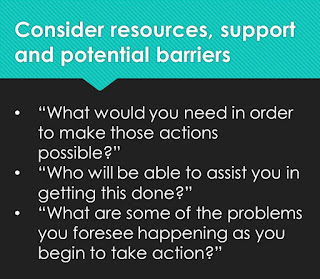
As such, as a coach, I recognize my responsibility to highlight these three important elements with questions such as, “What would you need in order to make those actions possible?”, “Who will be able to assist you in getting this done?” and “What are some of the problems you foresee happening as you begin to take action?” followed by “What could you do to give you the upper hand if and when this barrier pops up?”


6. Partners with the client to summarize learning and insight within or between sessions

This pointer is to do with the closing of the session or of a learning episode during a coaching session. It is very eye opening for me as I have almost always make a summary when rounding up a learning episode or at the end of the session. Looks like I will not be doing it anymore. Instead I will need to pass this practice to my client. And what a wise move it is. It ‘forces’ the client to pause and identify, solidify and present insights in succinct detail. In other words the client identifies her lesson and presents it to the coach! And I am certain what the coach had planned to say in his summary would most probably be miles away from what the client presented! If so, this part of the coaching session could be a learning opportunity for the coach too. “How would you describe what you understood about your described situation?” and “If you were to summarize the key lesson you got in this session, what would you say?” could be questions a coach could ask to assist the client to summarize insights gained.

7. Celebrates the client's progress and successes

This point assumes previous goals are monitored and there’s some kind of reporting back of progress and successes being experienced. Is this initiated by the coach (“How’s progress on your action plans you set last week?”) or is it solely left to the client to report her progress and successes? Even so, it makes sense that all progress and successes should be celebrated. I like what a trainer suggested: ask your client how best she would like you to celebrate her progress and successes when shared. The possibilities can range from a simple, “Wow, that’s great!” to a celebratory drink or meal! Again, letting the client decide may be a better and wiser move.

8. Partners with the client to close the session

When I first read this point, I thought it was referring to ending the coaching but it seems to be more about bringing an end to that particular day’s session. This point left me stump. How do I partner with my client to close the session? Shouldn’t I close the session as the coach – “Well, it’s already two hours and we have covered much. Let’s call it a day and I’ll see you next month” – or is this idea of ‘It’s all about the client’ also applied to how a session is closed? Looking forward to some increased understanding on this in upcoming sessions.

In conclusion, what I enjoyed most from this web-torial is the reminder that the ultimate purpose of the coaching session is to enable the client to transform insights into successful actions. “So what are you going to do now?” seems to be a good question to end this assessment. “The learned men (or people) are those who act after knowing.” – Ash Sha’bee in Siyar 4/303.


Thursday, November 4, 2021

Creating Awareness via Powerful Questioning

Overwhelming. Daunting. Challenging.

These three words describe what I felt and thought as I went through this week’s web-torial covering Core Competency 7 – Evokes Awareness. There was so much information and must-do’s to understand and it made sense why when I learnt that this ‘new’ competency is a combination of three competencies from the former ICF Competency Model! As the information piled up, my sense of dread increased, wondering how will I be able to remember all that was required of me and then to do as required. This led me to conclude (again?) that coaching will not be a walk in the park but a (mental?) marathon requiring lots of practice and active, consistent participation in coaching. Though still in a contemplative state, I am thankful for this realization.

Questions. Questions. Questions.

Personally I think the title for the lesson would better reflect its content if it was reworded to say Evokes Awareness via Powerful Questioning. It is a pity Core Competency 6 in the older version – Powerful Questioning – was absorbed into the present Model. Questioning is the standard go-to identifying characteristic when coaching is mentioned. Any surface knowledge of coaching will quickly reveal the ubiquitous usage of questioning in all coaching sessions. Books and mentors exhort and emphasize the importance and techniques of questioning. So it strikes me odd that such a key element is absorbed into a bigger topic focusing on the result of questioning – awareness.

Know. Understand. Act.

It seems that the new version of this competency draws attention more to the desired results of the coaching session – awareness – rather than the tool used to produce the results – questioning. Awareness to me means helping the client to (maybe for the first time) know what she is actually thinking, believing or even saying. The coach then is to work with the client to understand this revelation – to identify its key components, causes and players – in order to conclude with a desired action (the goal of the coaching endeavor). This process may take time and requires the coach to listen attentively in order to be aware of the real/underlying story and to bring that to the surface for the client. To be able to do this successfully is to be able to successfully evoke awareness.

I also realized the awareness a coach is to evoke encompass his own awareness as well as the awareness of the client. Being in the moment, sensitive to what is being experienced in all parts of our being – body, soul, spirit – while drawing insights that would help the coach manage himself as well as contribute to the client is also a part of the awareness exercise. A challenge I think I will need to control is the excitement to create conclusions for the client with the rising awareness being created especially if I feel the client is not getting it. Yet, I need to remember, the path ahead is created by the client without any interference or inference from me as to where that path should be carved out.

In the definition for Evokes Awareness, ICF cleverly combines the desired result of coaching – creating CLIENT insight and learning – and the tools a coach will use to do so – powerful questioning, silence, picture words (metaphor and analogy). I find helping the client gain insight and learn exciting and challenging because it’s a new skill for me and a life transforming experience for the client. What makes it challenging for me, I conclude, is the heavy dependence of powerful questioning which is a whole new world to me, a skill to be developed and wisely employed. And that is what I felt I did not get enough from this week’s web-torial: How to create powerful questions?

Looking at the eleven sub-points for this competency, it becomes clear almost all of them requires questioning! To be aware of the client’s experience you would need to ask questions. To challenge the client you would need questions. Sub-point 3 and 4 begins with the words ‘Asks questions’! To invite a client to share requires questions as well as when seeking to help the client identify influencing factors in her life. As such, I hope there will be some lessons in the future focused only on Questioning to help increase my understanding and confidence in creating and using Powerful Questioning.

Though not really highlighted during this week’s web-torial, I was made aware again of the need to be silent (to listen one must shut his mouth), to be comfortable with silent waiting, allowing the client to ruminate and resolve what was brought up through powerful questioning. As clearly pointed out in my first practicum, this is an area of weakness I will need to work on. This silence I believe also covers inward silencing of mental chatter and creating an inner calmness, waiting expectantly for revelation to emerge from the client.

Picture words. Love them. Experience as an English teacher and my interest in beautiful words lends a joyful lift to my spirit when I realized metaphors and analogies is a key tool in helping my client become aware. A picture does paint a thousand words and days when I am able to create a suitable picture word to encapsulate key yet difficult concepts that helps my student get it, I am engulfed in relief and celebratory joy. I look forward for similar episodes with my future clients, seeing the light come on in their mind and the smile of recognition on their faces.

I am also intrigued by the concept of asking questions to lead the client out of her present situation (the box she is in) into the possible and desired future. Many of my questions in the past have been to help my client review her past or present situation but I can’t remember having asked many questions that leads my client to imagine a future, to create a future or to be aware of a future not tainted by her past and present situation. Maybe it’s because it’s a difficulty I have and something I am still working to overcome by realizing and embracing truths that my future is not determine by my past and the factors that affected me in the past and present may not exist in the future, thus giving me opportunities to create a different (new?) future.

All talk, no action.

This is a trap I must not fall in when coaching. If no tangible action is actually taken after much effort from coach and client to generate awareness, then coaching just becomes an elevated chit-chat session. Maybe ”So what will you do this week?” would be a suitable question to ask after an a-ha moment occurs to help the client ‘generate ideas about how they can move forward and what they are willing or able to do’. I just love this sub-point as it takes the whole creating awareness exercise to a higher level. Awareness is not the end-all but the required platform for the next step – transformative action. This I believe is the ultimate goal of coaching and to not use powerful questioning to help the client come to this stage is such a waste. I am glad that ‘ideas’ is written in plural for indeed there actually is more than one way to skin a cat! This gives the client options and hope that a way forward is available – she just has to select one of many. And how to know which path to select? “Which path are you willing or able to do?” Maybe this will be acknowledged as a powerful question, a question that not only helps the client select but also be confident that the path she has selected is do-able.

To end my rambling assessment, I must say that I am slightly relieved that a little room is provided for the coach to speak and to share input without using questions (and yes, I know, speak briefly even so) by sharing ‘observations, insights and feelings, without attachment (need to understand this phrase more) which generates more awareness for the client’. I believe (correct me if I got this wrong) certain life experiences of the coach when shared at the right time could help bring clarity and insight for the client. I also think this last sub-point gives room to the coach to bounce off the client what he senses as he hears the client speak, watches her facial and body movements as well as any changes in her energy level and tone of voice, to ascertain its validity as well as help the client see what others see which she may be oblivious to. Again, all this to create awareness for the client to generate insight and learning.

As I type all this, the image of a wise master in some far away temple, in white robes stroking his white beard, listening to an impatient, sobbing youth as he pours out his woes comes to mind. All the time the master is silent. Finally when the youth is all done and all has quieten down, the master walks away, stares at the stars and after a protracted silence, turns and asks a powerful question. An amazing adventure begins (for the youth). A picture of coaching?

When a powerful question impacts your client, transformation beckons.

The Proof Is In The Practicum

  A fellow asked a wise man, “Which way is success?” The wise man said nothing and gestured towards a path. The man feeling elated, rushed a...